Design approaches are most celebrated for bringing user/people/customer/citizen perspectives into decision-making; as organisations and teams face increasingly complex challenges design’s biggest contribution to society and business in the future will be changing the way we think though problems. Design offers a process and a wide range of tools that can help us all collaborate in new ways, breaking down silos, visualising challenges, supporting experimentation and accommodating the needs of all stakeholders (including the planet).
Across the public sector, healthcare, education, government and other complex organisations, professional teams are creating and delivering extensive service ecosystems. The work of these silent designers can be transformed with the acquisition of some core design skills. Today we were working with the extended management team of Leisure and Culture Dundee to develop new approaches to innovation across a broad portfolio of delivery that includes everything from libraries, concert venues, sport & leisure facilities, museums and an observatory through to a wildlife centre.
Over the summer I have been working with health and care professionals in various health boards and trusts building visual maps of a wide range of healthcare ecosystems. These maps show what the an area of health and care look like from a patient perspective, in particular:
– Stages in the patient journey – Who the patient interacts with – Where interactions take place – Connections between health and care pathways experienced by patients
Building the maps is always interesting, the mapping workshops bring health and care professionals together from different parts of the system, allowing them to collaborate and see their system of care as whole (often for the first time).
Once mapped these visual representations support many opportunities for review and improvement. Collaborative review workshops explore:
– What are the aims of the system? – From a patient perspective, what is working well and what is challenging? – What is driving change? – What does flow rate data tell us? – What improvements have been initiated? – What challenges remain? – What are possible improvements? – What would a preferable 2030 ecosystem look like?
It’s fascinating to see the role design approaches and visual mapping play when working in complex systems.
Over the last month, the contribution ‘design thinking’ can play in facilitating complex discussions in organisations, has come ups in many conversations I have had. (Today it was with Amy Taylor at Magnetic).
This is where design becomes an approach within more general problem solving and a route to resolving issues in business, government, healthcare and education – in other words designing things that are not things.
To apply design thinking to more abstract problems, the skillset of the designer needs to evolve as illustrated. Taking design to this new level has the same implications as for developing any profession – it means we need to build the underlying curriculum for design thinkers and then develop their professional knowledge through reflection in action. In this new world for design, outputs and impact are ultimately in the hands of the problem owners who are responsible for implementing change. Design therefore also needs to find new ways to measure the influence it can have on the working practices of others to really understand its contribution.
This week I have been running workshops in Design Thinking approaches with the Paediatric Team at the NHS Lothian Royal Hospital for Children & Young People in Edinburgh. Healthcare’s long established paradigm of innovation through quality improvement is very powerful. There is a lot to be learnt, however, from how different design disciplines define and solve problems, in particular how designers:
– Takes a step back to see the bigger picture – Create solutions driven by user needs – Integrate human needs with science and technology – Future proof ideas by building understanding of future scenarios – Translate multiple ideas into a tangible solution – Work creatively and iteratively – Communicate visually
This week we explored how through the use of tools and templates we can bring this design thinking into healthcare improvement. Clinicians, Nurses & Allied Health Professionals are all ‘silent designers’ (as defined by Dumas & Gorb), they design the healthcare pathways and healthcare systems that we all use, these teams are highly receptive to augmenting their existing skills with new approaches from design.
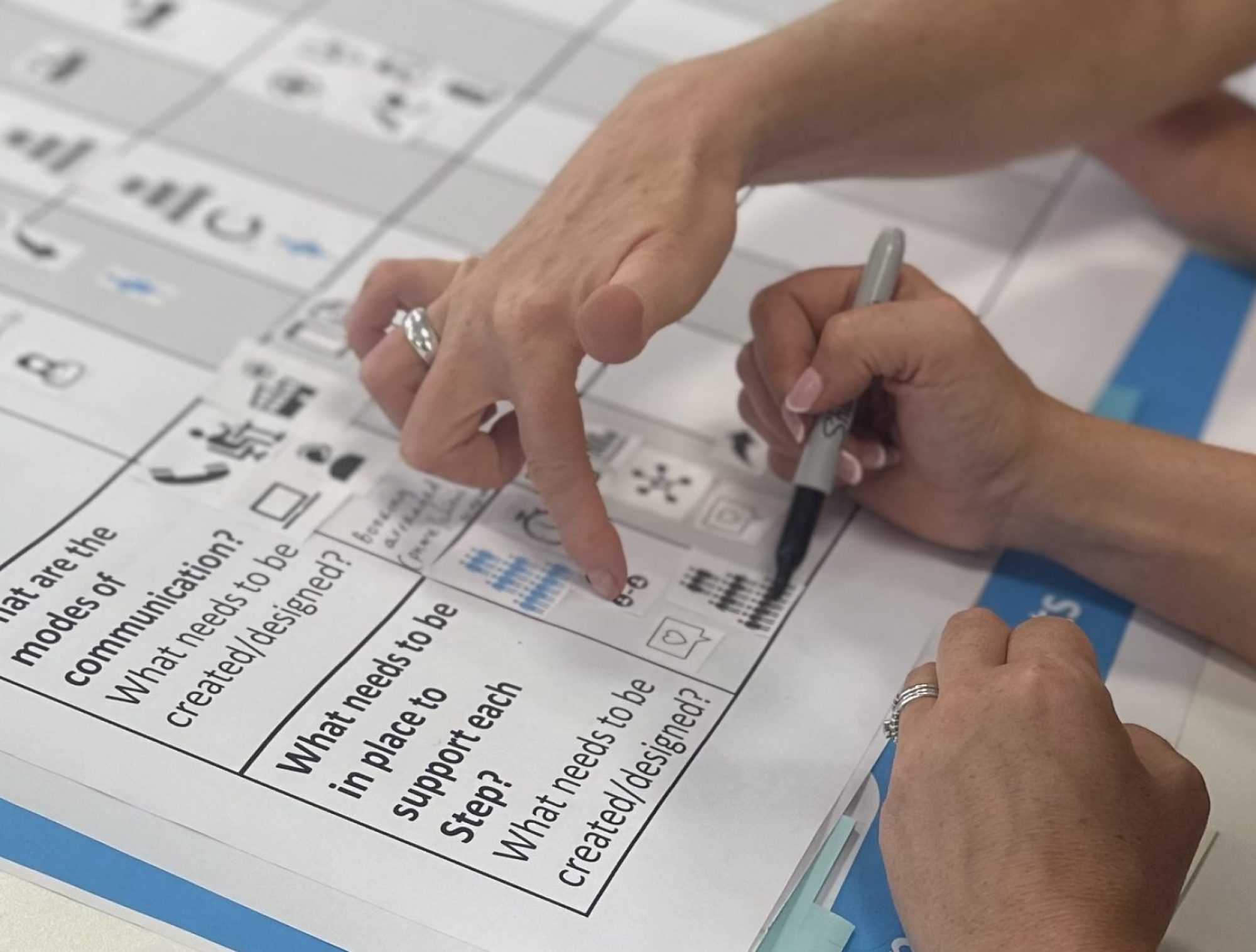
This week I have been running training in Patient Ecosystem Mapping with the Paediatric Team at the NHS Lothian Royal Hospital for Children & Young People (RHCYP) in Edinburgh. The workshop explored the stages involved in creating a Patient Ecosystem Map, and in particular strategies for:
– Deciding the geography of the map – Deciding which patient groups to include – Deciding which pathways to map
Using templates and icon kits we quickly developed outline maps exploring different Patient Ecosystems associated with Paediatric Services at the RHCYP. We then explored the different ways that Patient Ecosystem Maps allow review of a system of healthcare. As always we learnt a great deal about the pressures within healthcare systems and in particular the need for effective collaboration between primary and secondary care. We also learnt about how Patient Ecosystem Maps allow the patient experience to be understood more clearly.
36 years ago Peter Gorb and Angela Dumas wrote their seminal paper on ‘Silent Design’ for the Design Journal.
In my professional work I come across ‘Silent Designers’ all the time. People who are innovating in their organisations, who have an in-depth knowledge about their products, services and systems but are often unaware about how design approaches can transform the way they think.
If you look across the full breadth of design disciplines there are some core skills and perspectives that add great value, these include the ability to:
– Take a step back to see the bigger picture – Create solutions driven by empathy with user & stakeholder needs – Integrate human needs with science, technology and other knowledge domains. – Future proof ideas by building understanding of possible scenarios – Translate & synthesise multiple ideas into a tangible solution – Work creatively and iteratively – Communicate visually
All of these skills can be acquired, but careful thought needs to be given to presenting them and nurturing them in a way that fits the innovation paradigm of the organisation. One post-it doesn’t fit all.
This week working with fellow Innovate UK EDGE Design for Growth (DfG) lead coach Sally Brazier and Magnetic‘s Design for Growth Hub Manager Sarah Lazell we delivered the programme’s second Unlocking Investment Through Design WORKSHOP.
We had a great turnout for the session with lots of opportunity for start-up and scale-up leaders to discuss their own investor journeys, in particular, what had worked well and what had been challenging.
The workshop explored how service design approaches such as Persona Building and Journey Mapping can be used as very valuable methods for helping time pressured entrepreneurs navigate the investment process from initial stages of awareness building through to agreement of terms. Two great new templates were shared with the group to help develop investor readiness
Strategy setting is important in all organisations. There are many conventions for describing: Mission, Vision, Objectives, Strategies, KPIs, OKRs and Policies. All have great logic and can capture the essence of an organisation and where it is going. Co-creating strategy can, however, quickly descend into a word smithing exercise, certain words raise vocabulary antibodies in others, rambling strategy statements have meaning in the moment but have a rapid half-life, often a team will not even be able to articulate that carefully crafted vision within weeks of a strategic plan being published.
In my work I am always keen to step beyond written descriptions by creating visual representations. It can be incredibly valuable for teams to share their mental models of how their organisation works and adds value, the evolution of these carefully thought through representations then becomes a blue print for future development. Working this way always seems to make it far easier to then write the plan … ‘a picture is always worth a thousand words’.
Most healthcare improvement focuses on incremental changes to patient pathways. The increasing pressures facing all healthcare systems, however, demand new systems-based approaches to help identify shared ambitions, challenges and opportunities for innovation. Today we ran a one-day workshop at the Ulster Hospital, South East Health & Social Care Trust to look at new ways to innovate within Urgent & Unscheduled Care. Over the last 5 weeks a comprehensive map visualising the connections between general practice, community based health and care, acute services and a myriad of agencies such as the Northern Ireland Ambulance Service has been co-created through a series of 90-minute online workshops attended by over 75 stakeholders. At today’s face-to-face workshop the map was used to define the aims of the service and current challenges, explore the patient’s perspective and identify opportunities for improvement across the system.
Going into the autumn of 2023, as winter pressures begin to impact Urgent & Unscheduled Care, the new whole-systems approach aims to deliver a paradigm shift in the way professionals collaborate with patients and service-users to deliver change.